Africa rollout planning
ISP Billing Software for African ISPs
ISP billing software for African ISPs must support more than a country label on a homepage. Operators need subscriber records, familiar payment methods, understandable currencies, reliable router services and communications that work in their market. Centranet provides country-oriented guidance and shared MikroTik billing workflows, while payment readiness varies by provider and merchant account. This guide explains how to plan an African rollout without confusing advertised coverage with a live collection integration.

01
Separate software coverage from payment readiness
Subscriber management, package design and MikroTik operations have many common needs across African markets. Payments are more specific: a provider needs the right country, currency, collection method and merchant approval. A country information page is useful guidance, but it does not prove a production transaction can be collected and settled for every ISP there.
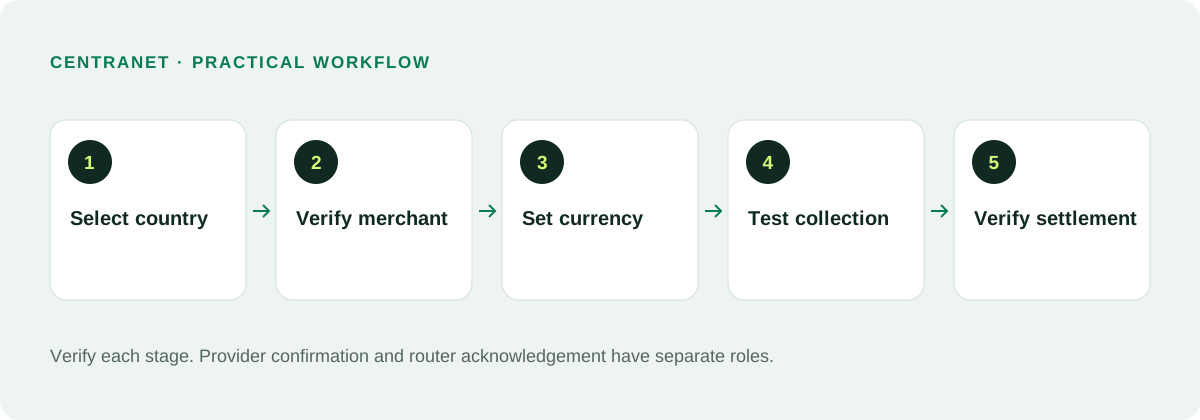
For each launch market, maintain a readiness checklist covering workspace setup, local currency behavior, merchant activation, callback verification, payout destination and support channels. Label a planned route as planned until it has passed live tests. This protects customers from paying into a workflow whose settlement rules are not yet established.
02
Use the country pages as a planning directory
Centranet’s country directory covers Kenya, Uganda, Tanzania, Ghana, Nigeria, Cameroon, Burkina Faso, Côte d’Ivoire and additional African markets. Open the relevant country page to review the listed integration context and requirements. Use it as the start of a merchant-readiness conversation, not as a blanket guarantee for every provider shown.
Country selection should also inform phone formatting, messaging decisions and the default workspace context. Check those defaults after registration. Some operators serve more than one country; their business needs may require separate merchant accounts or workspaces. Decide the model before creating packages and inviting customers.
03
Understand the current managed payment scope
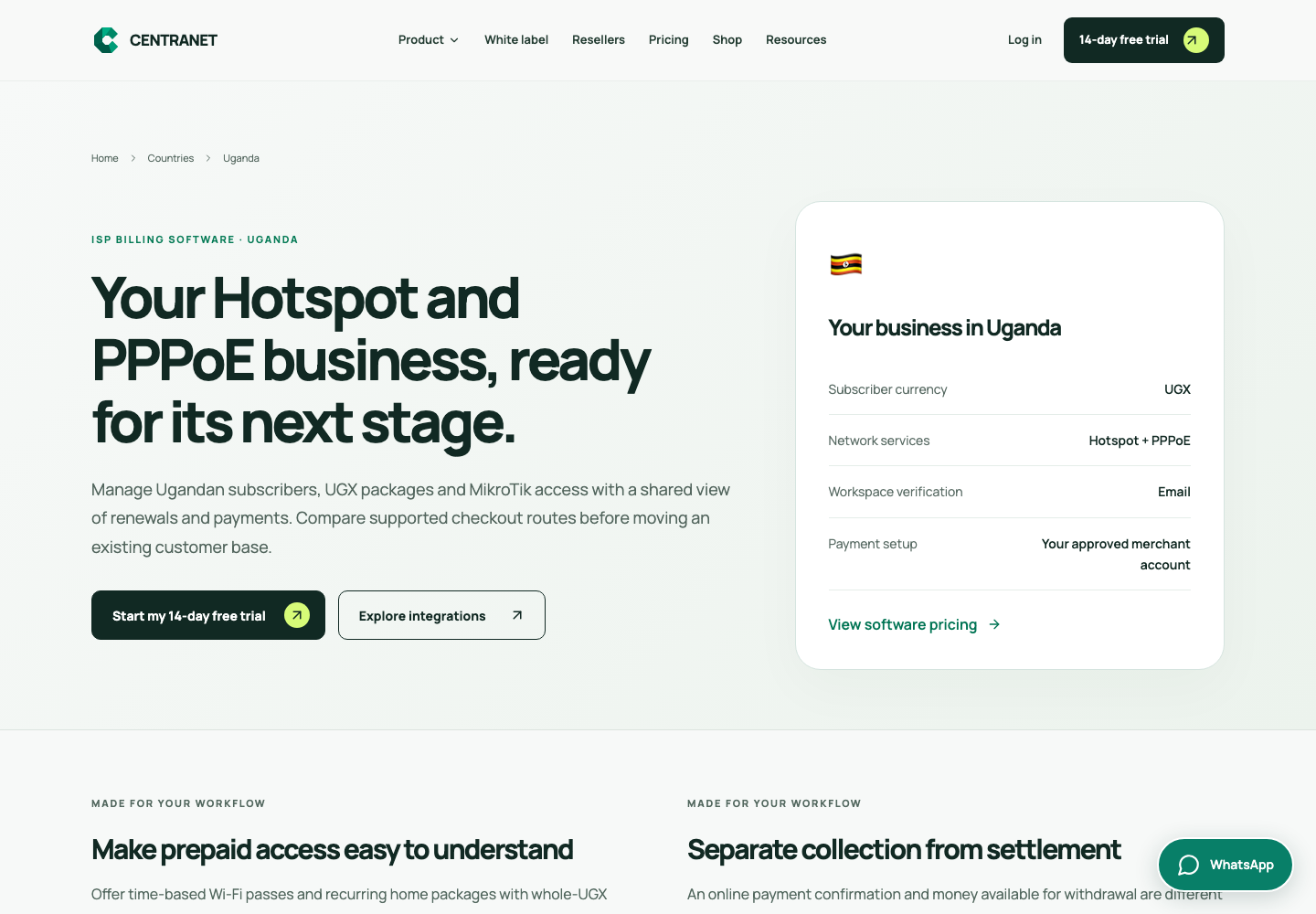
Kenya is the established Centranet managed collection market using the configured merchant route. IntaSend has confirmed support for mobile-money collections in Uganda and Tanzania, with collection in local currency and settlement in USDT subject to minimum balances. This confirmation does not by itself complete merchant integration, fees, funding or settlement configuration.
Ghana, Nigeria, Cameroon, Burkina Faso, Côte d’Ivoire and other markets should not be advertised as active Centranet-managed IntaSend collection routes without explicit account confirmation and live verification. Foreign workspaces can use their own supported gateway where that integration is operational. Confirm each route with the country page, platform team and merchant provider before launch.
04
Keep subscriber currency and platform billing distinct
An ISP may price internet in its local currency while the platform subscription is invoiced in another billing currency. These are separate money flows. Store amounts with an explicit currency and avoid treating a localized estimate as an actual provider-supported checkout. A converted storefront figure should explain its exchange-rate assumptions.
Centranet subscription invoices currently remain in KES. Local subscriber currency support and presentation do not automatically make the platform subscription payable in every African currency. Verify the billed currency, collection currency and settlement asset before purchase. Never sum balances from different currencies into a single revenue figure without a documented conversion rule.
05
Assess a country-specific gateway
Choose a provider that supports the merchant’s actual business location and preferred customer payment methods. Review credentials, verification, collection limits, charges, callback security and settlement destinations. A familiar provider name is not enough: the required method may be disabled on the account or unavailable under its current product tier.
Test successful, failed and delayed payment outcomes. Confirm that the provider reference can be matched to the intended subscriber. For manual mobile-money references, verify that the route preserves a usable customer account identifier. Build the instructions around the tested workflow rather than copying Kenya Paybill language into an unrelated market.
06
Reuse the network workflow carefully
Router enrollment, packages and customer assignment follow the same operational principles across markets. For the clean MikroTik setup, confirm the required RouterOS version, hard-reset prerequisites and working internet access. Review protected interfaces and customer networks. A remote software rollout still needs a technician who understands the physical site.
Avoid assuming equal uplink quality, electricity availability or customer equipment in every market. Start with a representative site, test short Hotspot purchases and PPPoE renewal, then expand. Keep support notes about local conditions. Package speed and validity should reflect what the ISP can actually deliver.
07
Adapt communications to the available channels
Centranet onboarding SMS is intended for Kenya; other countries use email for onboarding. Welcome messages should tell owners to check spam if the message is not in the inbox. Confirm that email addresses are correct and monitor failed deliveries. Do not make access depend on an SMS route that is not configured for the country.
WhatsApp and other messaging channels require their own approved account, templates where applicable, recipient permission and delivery configuration. Business verification is not equivalent to unrestricted bulk messaging. Select the channels customers actually use and preserve a clear support route when a provider or customer device is unavailable.
08
Build a local customer experience
Use readable package names, accurate contact information and payment instructions appropriate to the market. Show the actual collection currency before checkout. If the ISP uses a branded portal, test its domain, logo, support actions and receipt language. Clear localization is operational detail as much as marketing copy.
Translate important purchase and support information where needed, but preserve the technical meaning of expiry, validity and payment confirmation. Avoid generating dozens of nearly identical market pages that say nothing useful. A country page earns trust when it explains the available workflow and the remaining requirements.
09
Protect data and respect operating obligations
Customer information, transaction history and router credentials need controlled access regardless of country. Use least-privilege staff roles and keep privileged provider settings restricted. Do not use production customer details in public guide screenshots. Retain financial records according to applicable requirements and the operator’s documented policies.
Privacy, direct-marketing and financial requirements differ between jurisdictions. Each ISP and reseller should understand its own responsibilities and use the published legal and privacy materials as a starting point, with local review where needed. No software vendor can make an accurate universal promise that one policy satisfies every African market.
10
Launch country by country with evidence
Choose one primary market, verify owner onboarding and run a small end-to-end service test. Confirm collection, ledger allocation, router authorization and payout or settlement outcome. Record provider fees and timing from the actual account. A successful test collection alone is not sufficient evidence that the full settlement path is ready.
Expand only after support can explain each step. Keep an integration readiness record for each country and review changes in provider support. Centranet’s Africa approach should offer a consistent operating platform while being candid about local payment differences. That is a more dependable foundation than promising every country has the same gateway today.
Related documentation and next steps
Use current product information and original provider documentation when planning your deployment.
Good questions. Clear answers.
Let’s clear
a few things up.
A little clarity goes a long way.
Ask us something elseWhich additional countries did IntaSend confirm?
IntaSend confirmed mobile-money collections for Uganda and Tanzania, with local-currency collection and USDT settlement subject to minimums. Merchant implementation and settlement details still need verification.
Are all twenty country pages live managed payment routes?
No. Country pages provide market and integration guidance. Production availability depends on the actual provider, merchant activation and tested configuration.
Can international workspaces use their own gateway?
They can use an operational supported merchant integration. Verify country, method, currency, callback and settlement support before collecting customer payments.
Are Centranet platform invoices in every local currency?
Not currently. Platform subscription invoices remain in KES; local subscriber pricing and currency presentation are separate concerns.